Lima Radon Mitigation (419) 721-6892
Radon Mitigation · Lima, OH

Radon Mitigation in Lima, OH

Allen County sits in EPA Radon Zone 1, and local homes commonly test between 5.0 and 7.6 pCi/L — above the 4.0 pCi/L action level at which the EPA recommends mitigation. A properly designed sub-slab depressurization system draws radon-laden soil gas out from under the home and vents it safely above the roofline. We install code-compliant radon mitigation systems across Lima and Allen County.

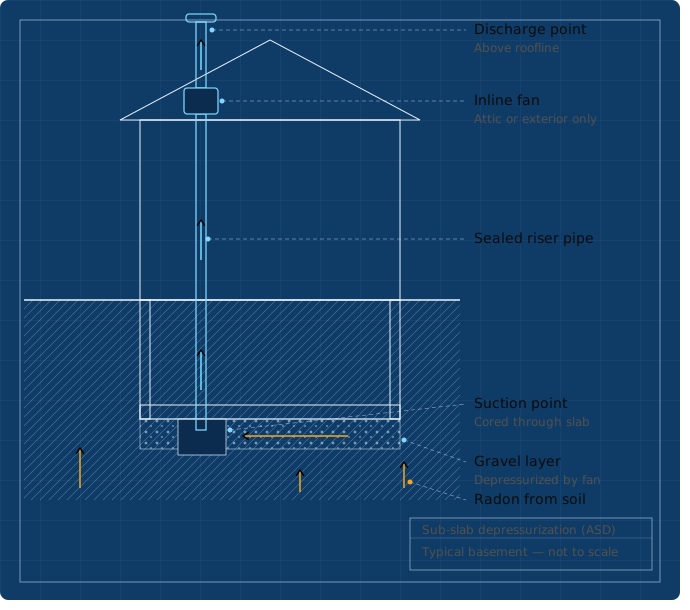
Blueprint cross-section of a sub-slab depressurization system: suction point in the slab, sealed riser pipe, inline attic fan, and discharge above the roofline

What's included

  • Sub-slab depressurization designed to reduce radon below 4.0 pCi/L
  • System sized to your foundation from an on-site diagnostic
  • Post-mitigation radon testing to measure the result
  • Sealed PVC venting routed to code above the roofline
  • Fan placement planned around your home’s appearance
  • Transparent pricing ranges up front (final price varies by home)

Why Allen County homes need radon mitigation

Radon is a colorless, odorless radioactive gas produced as uranium in the soil breaks down. You cannot see it, smell it, or taste it — the only way to know your level is to test. The EPA sets the action level at 4.0 pCi/L (picocuries per liter), and recommends fixing any home at or above it.

Lima and the rest of Allen County are in EPA Radon Zone 1, the highest-risk tier, where the predicted average indoor level is at or above 4.0 pCi/L. Locally, homes commonly test in the 5.0–7.6 pCi/L range. The reason is geological: Allen County sits on glacial till over fractured limestone bedrock. That uranium-bearing till and the cracked carbonate beneath it let radon-laden soil gas migrate up and collect in basements and lower levels — which is why radon is so common in Lima-area basements.

The health stakes are real: radon is the second-leading cause of lung cancer in the United States after smoking, and the leading cause among people who have never smoked. The good news is that it is completely fixable. A radon mitigation system is a permanent solution that vents the gas safely above your roofline before it ever enters your living space.

How a radon mitigation system works (the stack effect)

Homes naturally pull air upward — warm air rises and escapes at the top, creating a slight vacuum at the lowest level that draws replacement air, and soil gas, in through the foundation. This is called the stack effect, and it is why simply sealing cracks is never enough on its own: the house keeps pulling, and radon finds every remaining gap.

A radon mitigation system reverses that pull at the source. We create a low-pressure zone under your foundation slab and use an inline fan to continuously draw soil gas out from beneath the home and vent it up a sealed pipe to above the roofline, where it dissipates harmlessly. Because the system captures the gas before it enters, it protects the whole house — not just one room.

Radon mitigation system types we install

Active sub-slab depressurization (ASD) is the workhorse of radon mitigation — roughly 90–99% of installations. We core a suction point through the basement or slab floor, connect sealed PVC piping, and run an inline fan that keeps the sub-slab area under constant negative pressure. Piping can be routed through an interior chase or up an exterior wall depending on your home.

Drain-tile depressurization taps an existing perimeter drain-tile loop as the suction network, which can be highly effective when the tile ties the whole footprint together. Sump-pit and hollow-block-wall suction pull from an existing sump pit (sealed with an airtight lid) or from the cores of a block foundation wall — useful where the slab is hard to reach.

Sub-membrane depressurization is the crawlspace solution: we lay a heavy sealed vapor barrier across the crawlspace floor and draw radon from beneath it. Passive systems (common in newer construction with a radon rough-in) can be activated by adding a fan. Air exchangers / HRV dilution is used only as a last resort where soil suction is not feasible. We choose the method after a diagnostic — not off a template.

The radon fan matters — and we size it to your home

The fan is the heart of the system, and one size does not fit all. A tight, low-permeability sub-slab needs a high-suction fan; an open gravel bed under the slab needs high airflow instead. Matching the fan to the soil and foundation is the difference between a system that passes at 1.5 pCi/L and one that limps along at 3.9.

We install and stock proven radon fans and select by your diagnostic results: RadonAway (e.g. the RP145 at roughly 135 CFM, and the higher-suction GP-series), Fantech (e.g. the FR-150, around 243 CFM at 1.6 inches of water column), AMG Maverick (around 220 CFM at 1.88 in. WC), and FESTA fans. Higher water-column-inches means more suction for tight slabs; higher CFM means more airflow for permeable ones. We size for the lowest reliable radon level at the quietest, most energy-efficient operating point.

Our install process, step by step

1. Free diagnostic — we run a soil-communication / pressure-field test (and, where useful, a smoke test) to locate the best suction point(s) and confirm how easily air moves under your slab. 2. System design — we set the number and location of suction points from that diagnostic, not a guess. 3. Suction point — we core a ~5–6 inch hole in the slab and remove roughly 15–20 gallons of soil or gravel to open a collection pit.

4. Piping — we run sealed PVC up through an interior chase or an exterior wall. 5. Fan — mounted in the attic or outside, never in occupied space, per code. 6. Vent termination — the pipe exits above the roofline (at least 12 inches above the eave and clear of windows), per code. 7. Sealing — we seal foundation cracks, the sump lid, and other entry points with urethane caulk so the system does not fight air leaks.

8. Monitoring — we install a U-tube manometer so you can see at a glance the system is running, and a system label with the install date. 9. Final analysis — we verify airflow and suction. 10. Verification — a post-mitigation radon test measures the finished system against the EPA action level of 4.0 pCi/L.

How much does radon mitigation cost in Lima?

Most Lima and Allen County single-family homes fall in the $800–$1,800 range for a complete system. Larger homes, crawlspaces, multiple suction points, block-wall systems, or difficult routing typically run $2,000–$3,500. A radon test runs about $125–$175, a fan replacement about $300–$500, and adding a dedicated electrical circuit for the fan about $150–$450 when needed.

Final price always varies by home — foundation type, square footage, sub-slab conditions, and how the piping has to be routed all move the number. A firm written quote is provided before any work starts. Be cautious of quotes far under this range; a cut-rate system that never gets a home below 4.0 pCi/L is not a bargain.

How the result is measured

The point of a radon system is a measurable result — an indoor level below the EPA action level of 4.0 pCi/L. Rather than assume the result, a post-mitigation radon test measures it. Proper design matters here: fan sizing, suction-point placement, and sealing all determine whether a system actually reaches a low, stable level.

Radon levels naturally fluctuate with weather and season, so a system is judged on a proper post-mitigation test rather than a single spot reading. That measurement is what shows where a specific home stands relative to the action level.

After installation: testing and maintenance

Installation is carried out on site and the work area is left clean when the job is finished. Because radon can only be confirmed by measurement, a post-installation radon test is the step that shows how the finished system is performing.

A radon system needs a fresh test after installation to confirm performance (usually within 30 days), and re-testing every couple of years and after any major foundation or HVAC work is recommended. The mitigation fan itself is a low-maintenance, continuously running unit; the manometer tells you at a glance that it is doing its job.

Why cut-rate radon systems fail

A radon system is only as good as its design, and the cheapest bid is often the most expensive mistake. Under-sizing the fan, guessing at suction-point placement instead of running a diagnostic, skimping on sealing, or terminating the vent incorrectly can all leave a home hovering right at the action level — technically "mitigated," but not actually safe. When that happens, you pay twice: once for the failed system and again to have it corrected.

The tell-tale shortcut is a contractor who tests their own work once, gets a single reading under 3.9 pCi/L, and calls it done. Levels fluctuate, so a one-time squeaker is not proof. A sound approach designs from a diagnostic, sizes the fan to the foundation, and confirms the outcome with a proper post-mitigation radon test.

Why choose a local Lima radon specialist

National lead-gen sites and out-of-town chains route Lima searches to crews who do not know Allen County’s ground and may be hours away when a system needs a follow-up visit. Radon is a local problem with a local cause — our glacial-till-over-limestone geology and the 5.0–7.6 pCi/L levels that come with it — and it is well suited to a contractor who works and tests in the area.

Being local also means working on your timeline, which matters most during a home sale. We know the West-Central Ohio housing stock, carry the fans and materials the job needs, and are down the road if a system ever needs service.

Local to Lima & Allen County

Radon work in Ohio is regulated by the Ohio Department of Health, which licenses radon mitigation contractors (RC#) and radon specialists (RS#), and mitigation professionals are generally NRPP- or NRSB-certified. When hiring any radon contractor, ask to see their current license, certification, and insurance [insurer on file] on the proposal — a legitimate contractor will always show them.

We serve Lima and all of Allen County — Elida, Delphos, Bluffton, Spencerville, Cridersville, Beaverdam, Harrod, and Lafayette — plus the surrounding hubs of Wapakoneta, Ottawa, Van Wert, Kenton, and Findlay. Request a quote through the form and we will follow up with next steps.

Frequently Asked Questions

What is radon?

Radon is a naturally occurring radioactive gas produced when uranium in soil and rock breaks down. It is colorless, odorless, and tasteless, so you cannot detect it without a test. Outdoors it dilutes harmlessly; indoors it can build up to unsafe levels, especially in basements and lower floors.

How does radon get into my home?

Homes naturally draw air upward and pull replacement air in at the lowest level — the "stack effect." That slight vacuum sucks radon-laden soil gas in through foundation cracks, floor-wall joints, sump pits, and gaps around pipes, where it concentrates in basements and lower levels.

Does radon have a smell or color — can I detect it myself?

No. Radon is completely invisible and odorless. There are no symptoms of exposure in the moment. The only way to know your level is to run a radon test.

Why is radon dangerous?

Radon is the second-leading cause of lung cancer in the United States after smoking, and the leading cause among people who have never smoked. The risk builds with long-term exposure, which is why fixing an elevated level matters.

Has anyone actually died from radon exposure?

Radon is estimated by the EPA to cause roughly 21,000 lung-cancer deaths per year in the U.S. It is a long-term exposure risk rather than an immediate hazard, which is exactly why testing and mitigation are worth doing before problems develop.

How serious is radon in Lima and Allen County, Ohio?

Serious. Lima and all of Allen County are in EPA Radon Zone 1 — the highest-risk category — and local homes commonly test between 5.0 and 7.6 pCi/L, well above the 4.0 pCi/L action level. The cause is our geology: glacial till over fractured limestone lets radon migrate up into basements. Testing here is strongly recommended.

My neighbor tested high — does that mean my house is high too?

Not necessarily, but it raises the odds. Radon levels vary house to house even on the same street, depending on foundation, construction, and soil pathways. In a Zone 1 area like Allen County a neighbor’s high result is a good reason to test your own home rather than assume.

Does radon only affect old homes or certain types of homes?

No. New and old homes, with or without basements, on slabs or crawlspaces, can all have elevated radon. Newer homes sometimes have a passive radon rough-in, but in a high-radon area that often is not enough on its own. Only a test tells you where a specific home stands.

Why should I test for radon?

Because you cannot see, smell, or taste it, and because Allen County is a high-radon area. Testing is inexpensive, and it is the only way to know whether your home is above the 4.0 pCi/L action level — for your family’s safety or for a home sale.

How is a radon test done and how long does it take?

A short-term test measures radon over about 2 to 7 days; a long-term test runs 90+ days for a truer annual average. Continuous radon monitors record hour-by-hour and resist tampering, which is why they are preferred for real-estate transactions.

Can I test myself, or should I hire a professional?

DIY test kits exist and are better than not testing. For a home sale, an existing-system check, or a result you want to act on with confidence, a professional test (especially a continuous monitor) is more reliable and provides documentation buyers and lenders accept.

How often should I re-test?

Test if you never have, if it has been more than two years, before or during a home sale, after major foundation or HVAC work, and after any mitigation system is installed. If you have a system, a periodic re-test confirms it is still holding your level down.

What is a safe radon level? What does the EPA recommend?

The EPA action level is 4.0 pCi/L — at or above it, mitigation is recommended. Between 2.0 and 4.0 pCi/L the EPA suggests considering a system. There is no completely "safe" level, so the goal is to get as low as reasonably achievable; well-designed systems are built to reduce levels well below the 4.0 pCi/L action level.

Can a radon test be cheated or gamed?

Short-term tests can be affected by open windows, running fans, or moving the device, which is why closed-house conditions matter and why continuous monitors that log tampering are preferred for transactions. A professional test protects everyone in a sale.

My test came back low — am I in the clear?

A low result is good news, but radon can change over time and with the seasons. If you are below 2.0 pCi/L, re-test every few years and after major home or HVAC work. If you are between 2.0 and 4.0, the EPA suggests considering mitigation.

What is a radon mitigation system and how does it work?

It is a fan-and-pipe system that creates suction under your foundation and continuously vents radon-laden soil gas up above the roofline before it enters your home. Because it captures the gas at the source, it protects the whole house permanently.

What is the difference between an active and a passive system?

A passive system uses only the natural stack effect to move radon up the pipe — helpful but often insufficient in high-radon soil. An active system adds an inline fan for constant suction, designed to bring levels below the 4.0 pCi/L action level. Activating a passive rough-in is usually a quick fix.

Do I actually need a mitigation system?

If your home tests at or above 4.0 pCi/L, the EPA recommends one. In Allen County, where homes commonly read 5.0–7.6 pCi/L, many do. Test first — the result tells you whether and how urgently a system is warranted.

Are radon mitigation systems ugly or unsightly?

A well-designed system is discreet. Piping is routed through an interior chase or neatly up an exterior wall, and the fan sits in the attic or outside. We plan the routing with your home’s appearance in mind, especially on the street-facing side.

Isn’t sealing the cracks enough on its own?

No. Sealing helps a system work better, but on its own it cannot overcome the stack effect — the house keeps pulling and radon finds any remaining gap. Reliable results require active suction beneath the slab, with sealing as a supporting step.

Does mitigation really work — how low will it get my level?

Yes. According to the EPA, a properly designed sub-slab depressurization system can reduce indoor radon substantially — often well below the 4.0 pCi/L action level. The result for a specific home is confirmed with a post-mitigation radon test rather than assumed.

Does the system need maintenance? How long does a radon fan last?

Very little maintenance — the fan runs continuously and the U-tube manometer on the pipe shows at a glance that it is working. Fans typically last several years of constant running before needing replacement.

How much does radon mitigation cost in Lima?

Most Allen County single-family homes fall in the $800–$1,800 range for a complete system; larger homes, crawlspaces, and multi-point systems typically run $2,000–$3,500. Final price varies by home, so a firm written quote is provided first.

How long does installation take, and can we stay home?

Installation is carried out on site, and in most homes you can stay put while the work is done.

What do I get when the job is done?

A labeled, code-compliant system with a monitoring manometer, a post-mitigation radon test that measures the result against the 4.0 pCi/L action level, and documentation you can use for a home sale.

How do I know a radon contractor is properly licensed and certified?

Radon work in Ohio is licensed by the Ohio Department of Health, which issues radon contractor (RC#) and specialist (RS#) credentials, and mitigation professionals are generally NRPP- or NRSB-certified. Ask any contractor to show their current license, certification, and insurance on the proposal — a legitimate one always will.

How is a radon system’s performance verified?

A radon system is judged on a measurable result. After installation, a post-mitigation radon test shows whether the home is below the EPA action level of 4.0 pCi/L — the honest check, since radon levels naturally fluctuate. Warranty and service terms vary by contractor, so confirm them on your written proposal.

Radon came up in my home sale — how fast can you install before closing?

Radon mitigation can usually be scheduled to fit a closing timeline. Tell us your closing date and the work — diagnostic, install, and a post-mitigation radon test that documents the result — can be planned around it, producing the report buyers and lenders need.

Do you provide the radon documentation the buyer, agent, or lender needs?

Yes. The post-mitigation radon test result and system documentation that buyers, agents, and lenders expect can be provided for the transaction. Put your deadline on the quote form and we will follow up.

Do you handle commercial, multi-family, or new construction?

Yes. We design multi-suction-point systems for larger footprints, coordinate testing across multi-family units, and activate passive rough-ins in new construction. Ask about batch scheduling for multiple properties.

Can I install a radon mitigation system myself?

In Ohio, radon mitigation is licensed work for good reason: fan sizing, suction-point placement, sealed routing, and code-compliant venting all determine whether a system actually gets a home below 4.0 pCi/L. A DIY system that does not perform is not a savings. Professional mitigation covers the design, the install, and the post-mitigation test that measures the result.

Request a quote for Radon Mitigation in Lima, OH

Free quote · same-day reply · no obligation.

Prefer to talk now? Call (419) 721-6892

Call Free Quote